The Original Records
Certified copies of your family's koseki registers, obtained lawfully from municipal offices across Japan — the actual government documents that carry your ancestors' names.
For Japanese American families — Sansei · Yonsei · Gosei
In a government office in Japan, a handwritten register has been quietly keeping your family's record — births, marriages, departures — for more than 150 years. We find it. We translate it. We return it to your family, where it belongs.
Complimentary first assessment · Registry research USD 4,000–6,000 + actual costs · Conducted by licensed Japanese legal professionals
The story begins below ↓How it usually begins
A parent passes. A house is cleared. And in the back of a garage, a leather trunk no one remembers opening: letters addressed in vertical brush calligraphy. Photographs of strangers standing before a farmhouse that is nowhere in America. A small silk charm from a shrine no one can name.
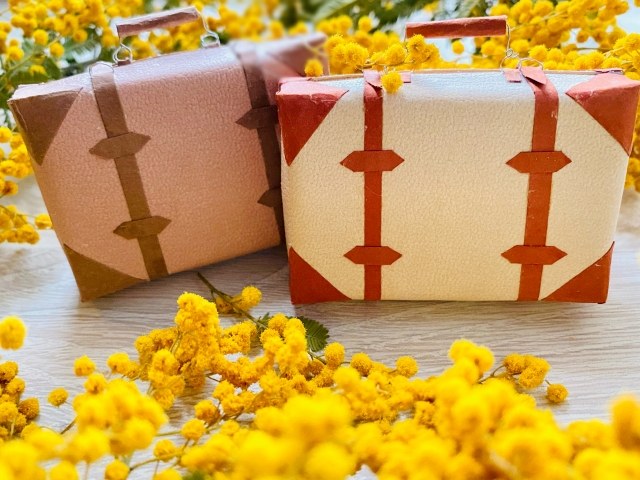
You are holding a letter written to your own family — and you cannot read a single character.
Where exactly was he born? Why did he leave? What did the war take, and what did the silence afterward bury? Who stayed behind in Japan — and who, today, still shares his blood?
The people who could have answered are gone. In America, the paper trail thins out at the internment years and disappears at the pier.
But on the other side of the Pacific, the record kept going.
Japan's family registry — the koseki
Since 1872, Japan has recorded every birth, marriage, adoption, and death — family by family, village by village — in a single continuous system called the koseki. It is arguably the most complete genealogical record on earth.
Your family has a page in it. Even after your ancestor sailed for America, even through war and internment, the registry in his home village kept his name — written by hand, in ink, by clerks who never knew the story they were preserving.
These registers are not online, and they are not public. Access is strictly regulated by Japanese law, and the prewar volumes are handwritten in classical Japanese that even most native speakers cannot comfortably read. This is precisely the work of a judicial scrivener: obtaining the records lawfully, reading them accurately, and turning them back into a family's story.
The deliverable
Certified copies of your family's koseki registers, obtained lawfully from municipal offices across Japan — the actual government documents that carry your ancestors' names.
Every register translated in full — name by name, date by date, notation by notation — so that what a clerk wrote in 1898 can be read aloud at your table.
Your complete direct line, compiled in English and Japanese and presented as an archival volume — made to be framed, shelved, and handed down.
A written account of what we found and what it means: the village, the household, the departures and returns — your family's story, documented and sourced.
Field research in your family's hometown — the temple, the graves, the old addresses — with photographs of the places your records describe, and, if you wish, a family chronology.
Where relatives can be identified from your family's own registers, a respectful first letter, in Japanese, at your request.
When you are ready to stand where your grandfather stood, we can help you prepare — the places in your records (temple, graves, old addresses) and what the records say about them. We do not arrange travel or accommodation.
The form of the deliverable
Below: the house of Tokugawa Ieyasu — the family of the shoguns — rendered in the bilingual form we use for client trees. Every name in kanji and in English, every line documented. Yours is built the same way, from your own certified registers.
Prepared from public historical records, for demonstration of form only — simplified for display. An actual client tree, compiled from certified koseki registers, carries far more information — full dates of birth, marriage, and death, registered domiciles, adoptions, and branch lines — and is correspondingly more complex. However far back yours reaches, it takes this same shape: every name in both languages, every line accounted for.
The process
Write to us in English. Tell us what you know — even if it is only a name and “somewhere near Hiroshima.” Complimentary and confidential.
We evaluate your clues — names, approximate hometown, emigration year, documents you hold — and tell you, free of charge, whether the line looks traceable and the expected range. You commit to nothing until you sign. Anything beyond the standard work is proposed separately, in writing.
A bilingual service agreement puts everything in writing: scope, fee, timeline, confidentiality.
We obtain and read the registers — office by office, generation by generation. Field research in Japan — when your case needs it, or when you ask for it — is always agreed with you in writing in advance. Most engagements run from six months to about a year, depending on the case — with progress reports along the way.
Records, translations, family tree, narrative — your family's archive, delivered to your door.
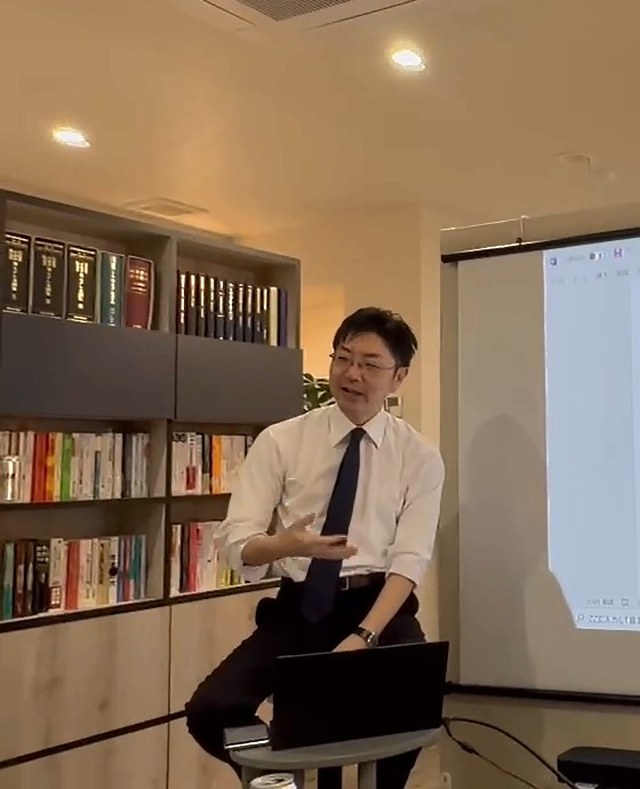
Hiroshi Takahashi — Judicial Scrivener, Co-Principal of Kakeru Legal Office
Who conducts your research
Hiroshi Takahashi has been a licensed judicial scrivener (shiho-shoshi) since 2010 and is a co-principal of Kakeru Legal Office in Hiroshima Prefecture. His practice is built on inheritance and family registry law — work in which tracing every branch of a family is not a hobby but a legal requirement, and in which a single case can require reading the registers of more than one hundred heirs.
It was inside that work that this service began. In record after record, he kept meeting the same quiet story: a young name, a village address, and a notation — emigrated to America. He began to wonder who those young people became, and who their grandchildren are now.
This is the answer: a research practice devoted to giving those grandchildren their story back — carried out by the licensed professionals of Kakeru Legal Office, under the duties the law places on them.
The book
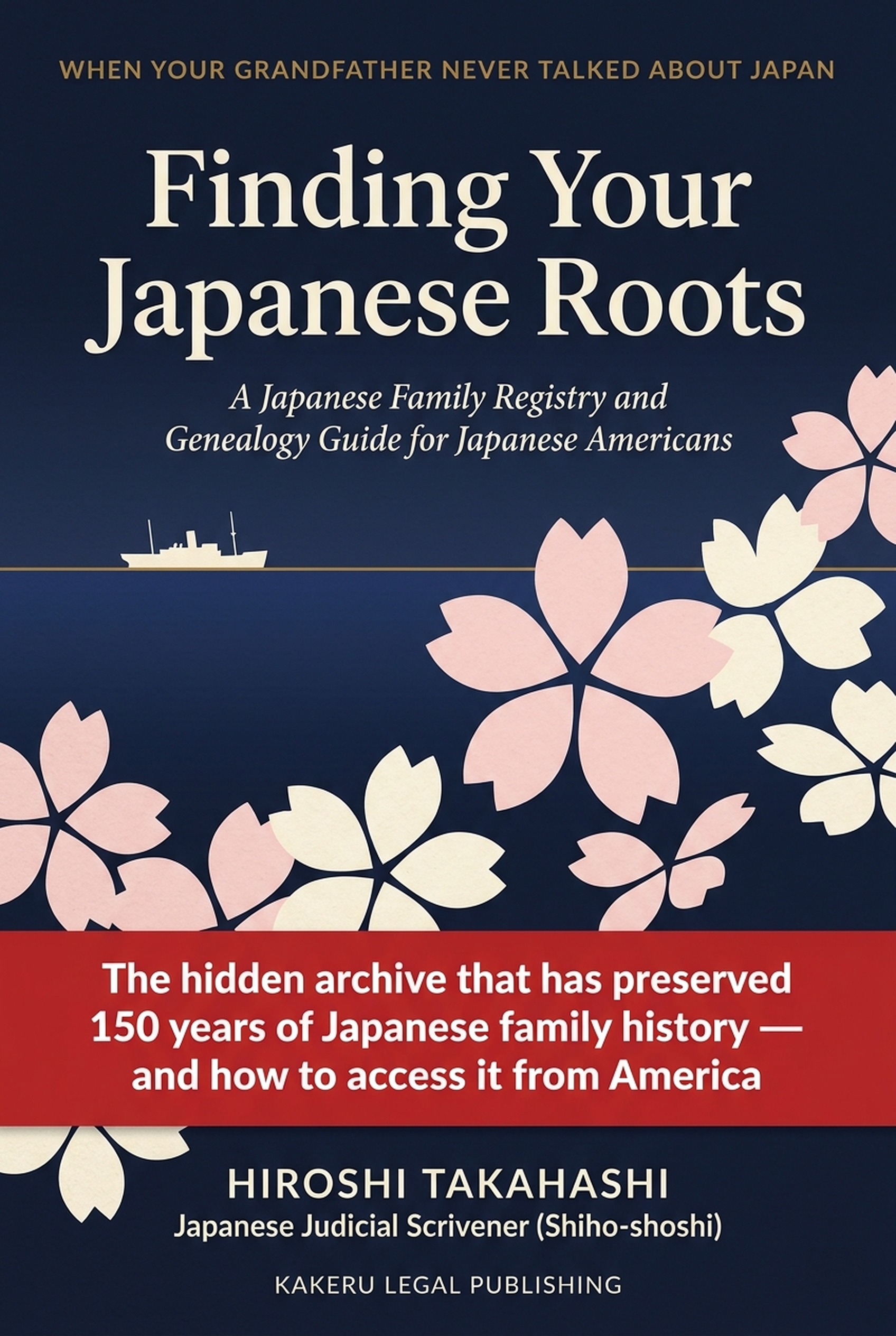
Finding Your Japanese Roots: A Japanese Family Registry and Genealogy Guide for Japanese Americans follows Jake, a third-generation Japanese American in San Jose, from the moment he opens his late grandfather's trunk to the moment the koseki gives him his family back. Along the way it explains, step by step, exactly how the search works:
If you would rather make the journey yourself, the book will show you the way — it holds nothing back. And when you want a professional to carry it for you, we are here.
The investment
No hourly billing. Send us what you know — names, dates, a hometown, old letters — and we will tell you, free of charge, whether the line looks traceable and which of the three cases below yours is likely to be. You pay nothing until you decide to engage us. Fees never change without your written approval; actual costs are itemized and billed at cost.
From collecting the koseki registers to the finished family tree. For when your ancestor's registered domicile in Japan is known, or can be found, and the line can be followed through the registers — the most common case. Where your fee falls within the range depends mainly on how many family lines you would like traced.
Actual costs — government fees for the registers, postage in Japan, and international delivery of your archive — are billed at cost, typically about USD 200–350.
The standard engagement already gives you the family tree. Some families want more — to see the place, or to hold a timeline of their ancestors' lives. Add only what you want; nothing here is required. Each addition begins only with a written proposal and your approval.
When there is nothing yet to request the registers with — your family's registered domicile in Japan is unknown, and the clues you hold cannot reveal it — and the starting point has to be found on the ground, in Japan.
A fixed retainer of USD 2,000 begins the work once you engage us; the balance, together with the itemized actual costs, is due before delivery. Fees are payable by international bank transfer or in USDC, the U.S.-dollar digital stablecoin — whichever suits you.
We will never promise what the records cannot give. Where a line cannot lawfully or physically be followed further, you receive a complete written account of everything we searched and everything we found — so that you, or the generation after you, can pick up exactly where we stopped.
Questions families ask
Begin
That is how every one of these stories begins — someone sits down at night and writes what little they know. Write in English. Tell us what you have, and what you have always wondered. We will reply within two business days, Japan time.
Our address
hiro-shiho-sho@kiu.biglobe.ne.jp
“Copy Address” works with any email — Gmail, Outlook, or your own. The mail-app button only responds if your device has a mail application set up.
None of these are required — families often begin with nothing but a single name.
Every inquiry is held in professional confidence — before, during, and after any engagement.